Apps › Stip: Number Bonds to 20 › Teaching approach
The teaching approach behind Stip: Number Bonds to 20
For teachers and parents who want to know why the app works the way it does: what it aims for, how the steps build up, and what Stip does when a child makes a mistake.
1. Aims: number bonds within 20
In England, the National Curriculum asks children in Year 1 to represent and use number bonds and related subtraction facts within 20, and to add and subtract within 20. In Year 2 they recall these facts fluently and use them, and learn that addition can be done in any order but subtraction cannot. In Ireland, the Primary Mathematics Curriculum covers the same ground in First and Second Class.
| Part of the party | What your child does | Roughly |
|---|---|---|
| 1. Balloons | Number bonds in the number house: within 5, then 6 and 7, then 8, 9 and 10 | Year 1 |
| 2. Necklaces | Bonds without the house: 7 is made of 4 and how many? | Year 1 |
| 3. Presents | Adding and taking away within 10, with swapped sums | Year 1 |
| 4. Streamers | Counting on to 10: which numbers make 10? | Year 1 |
| 5. Twenty cups | Tens and ones: the teen numbers | Year 1 |
| 6. Musical chairs | Adding and taking away within 20, without crossing ten | end of Year 1 |
| 7. Marbles | Adding across 10: make 10 first | Year 2 |
| 8. Tidying up | Taking away across 10: back to 10 first | Year 2 |
Schools plan their own order, so the year is a guide. In Ireland, think of First Class for the first six parts and Second Class for crossing ten.
2. Small steps, moving on when it goes smoothly
- Small numbers first. In the number house: within 5, then 6 and 7, and only then 8, 9 and 10.
- Swapped sums early and in pairs. When the smaller number comes first, your child can swap the numbers round: 2 + 7 is the same as 7 + 2.
- Adding first, then taking away. And small steps first, then bigger ones.
A round has six questions. It goes smoothly when no more than one question was not right first time; using help also counts as not first time. After three smooth rounds, that part is done and the next one opens.
3. Crossing ten: make 10 first
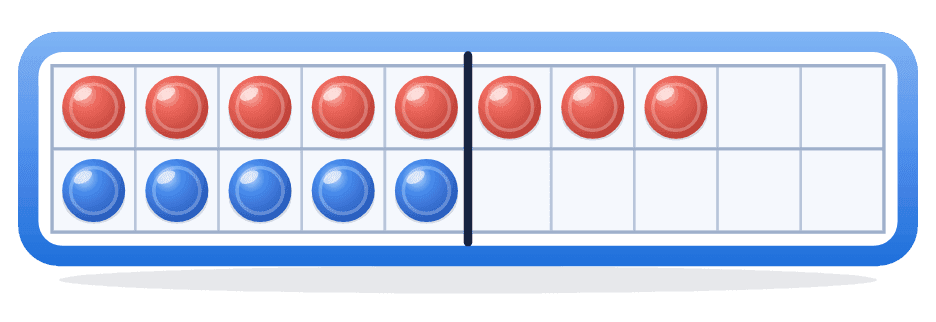
For sums that cross ten, Stip does not count on in ones. He makes 10 first, then adds the rest. For 8 + 5, he puts two counters in the top row of the twenty frame and three in the bottom row: 8 + 2 = 10, and 10 + 3 = 13. When taking away, he goes back to 10 first.
4. Mistakes: every wrong answer means something
The wrong answers in the app are mistakes children really make, and for each one Stip says what went wrong. The 555 questions contain 1,630 of these. The most common:
- Counted one too many or too few
You counted one too many.
- Gave the part that is already there
That number is already there. You are looking for the other part.
- Added instead of finding the other part
You added. Here you need to find the other part.
- Added instead of taking away
You added. Here you need to take away.
- Crossing ten, took the ones away the wrong way round
You took the ones away the wrong way round. First go back to 10.
- Forgot the ten
You forgot the ten. The ten stays.
5. Explanations and help
- For each new part, Stip explains it with the number house and the ten frame, in a few steps that move on screen.
- After a mistake, Stip says what went wrong and the child tries again.
- If it is nearly right twice, Stip shows the working out step by step.
- After twenty seconds without a tap, Stip offers help, one step at a time.
- When the answer is right, Stip also says why.
6. For every child
- Stip reads every question and explanation aloud, so children can practise before they read well.
- Your child taps an answer, types it, or places counters on the frame.
- Short games to build fluency, with no clock and no score.
7. What the app does not do
- No marks and no tests. For each part of the party, your child gets a sticker in their sticker book.
- What your child does stays on the device. A teacher does not see an overview of the class.
- The app does not replace lessons. It is made for practising what comes up at school, at your child’s own pace.